Who Is Justice William W. Hood III? Appointed by Hickenlooper in 2013, Rated 9-0, Colorado's Next Chief Justice, and on Every Douglas County Ballot This November
The only Supreme Court justice on the Douglas County ballot is a former 18th Judicial District prosecutor whose colleagues just picked him to run the court. Who appointed him, how he did in 2016, what the commission and its surveys say, and the May ruling people are searching for.
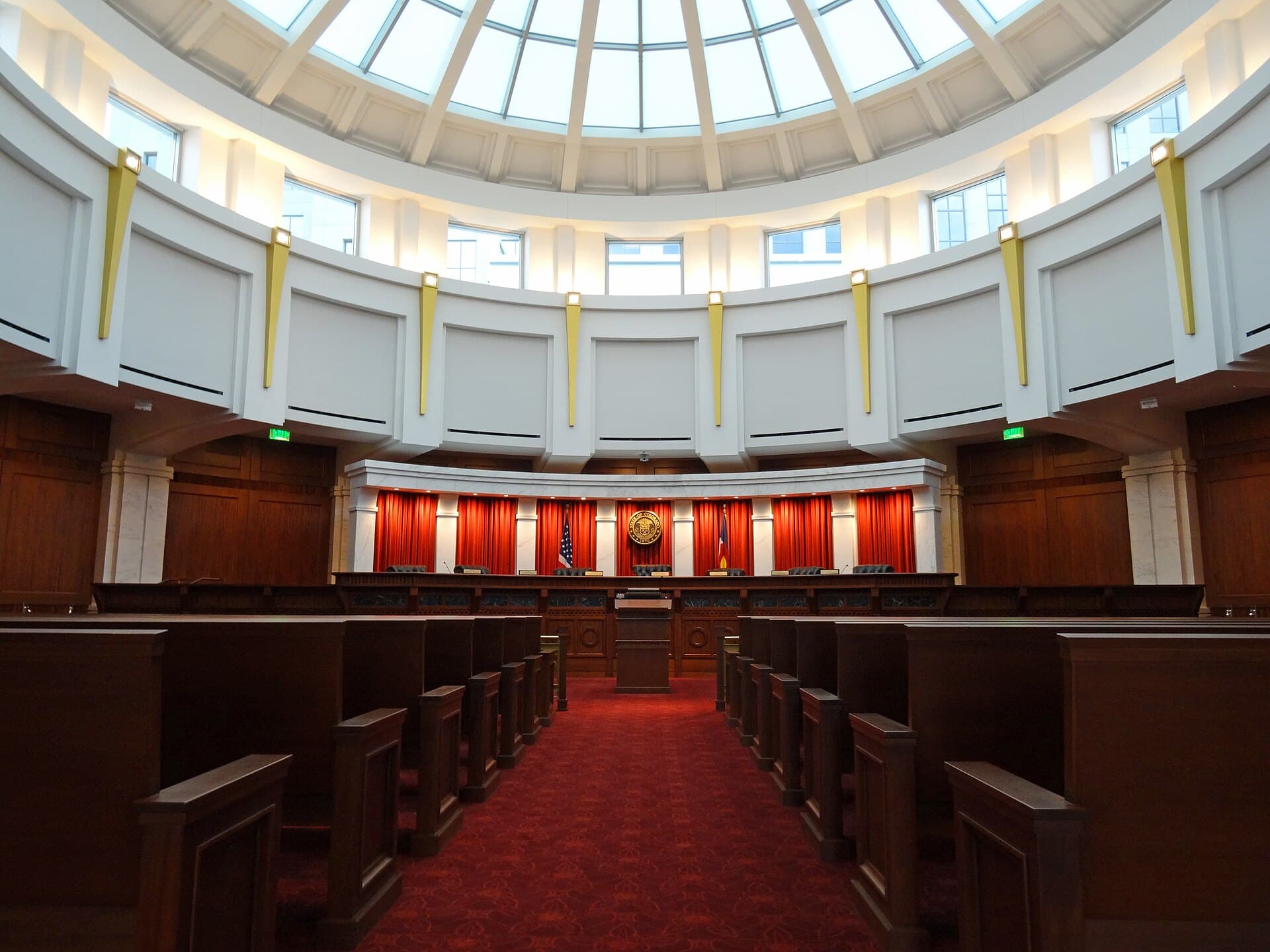
The Colorado Supreme Court courtroom at the Ralph L. Carr Judicial Center in Denver. Photo: Jeffrey Beall, CC BY 3.0, via Wikimedia Commons
William W. Hood III is the one Colorado Supreme Court justice on the Douglas County ballot this fall, and the question next to his name is the same one asked of the other twelve judges: shall he be retained in office? He has no opponent and does not campaign. He is also, as of August, the justice his colleagues chose to run the court starting next year. Here is who he is, from the governor's appointment announcement, the court's own records, the Secretary of State's results and the volunteer commission that evaluated him.
Who appointed him, and when
Gov. John Hickenlooper announced the appointment on Oct. 25, 2013. Hood, then 50 and a Denver District Court judge since 2007, filled the seat of Chief Justice Michael L. Bender, who had been on the court since 1997 and chief since 2010 and was retiring on Jan. 7, 2014. The governor's release counted him as the 103rd person appointed to the Colorado Supreme Court in the state's history. KUNC reported that the governor called it the most evenly divided selection he had made, with three finalists he considered well qualified. Hood took his oath on Jan. 13, 2014.
Under Colorado's merit system a nominating commission sends the governor a short list, the governor picks, and the new judge serves a two-year provisional term before facing voters. Hood's first retention vote came in 2016. This November is his second, for the full ten-year term that Supreme Court justices serve.
What he did before the bench
The local connection is real. Hood spent ten years as a prosecutor in the 18th Judicial District Attorney's office, which the governor's release described as "serving Arapahoe, Douglas, Elbert and Lincoln counties." At different times there he was the chief appellate deputy, a chief trial deputy and a deputy in the violent crimes unit. Douglas County's courts stayed in the 18th District until the new 23rd Judicial District opened in January 2025, so the office he worked in was the one that prosecuted Douglas County's felonies until the new district opened.
From the DA's office he went into private practice. The governor's release lists him as an associate at McKenna & Cuneo and Holme Roberts & Owen in commercial litigation, and the court's biography says he was a litigation partner at Isaacson Rosenbaum P.C. in Denver before moving to the bench. He joined the Denver District Court in 2007 and stayed seven years. The court's biography lists a Denver Bar Association Judicial Excellence Award in 2011 and the Colorado chapter of the American Academy of Matrimonial Lawyers' Distinguished Jurist Award in 2014. He graduated from Syracuse University in 1985, magna cum laude and Phi Beta Kappa, and from the University of Virginia School of Law in 1990, where he was on the Virginia Law Review. He has taught advocacy courses as an adjunct at the University of Denver's law school.
What the performance commission found
The State Commission on Judicial Performance, the volunteer body that evaluates every appellate judge up for retention, interviewed him, read a selection of his opinions, watched oral arguments, reviewed his self-evaluation and surveyed attorneys and judges. Its 2026 finding: he meets performance standards, 9-0, with one commissioner absent and one seat vacant.
The narrative is short and favorable. The commission found that he "is courteous to attorneys and treats parties equally without regard to race, sex, or economic status," that he "demonstrates an admirable work ethic and issues decisions in a timely manner," and that "he has a clear writing style that makes the reader's job easier." It called him "a valuable member of the Colorado Supreme Court."
"He has a clear writing style that makes the reader's job easier." The State Commission on Judicial Performance, 2026.
The survey numbers
The commission's contractor invited 295 attorneys and 253 judges; 7 attorneys and 24 judges answered. Six of the seven attorneys and all 24 judges said he meets standards. His overall score was 3.6 on a scale where 4 is "outstanding performance" and 2 is "adequate," in line with his interim scores of 3.5 to 3.9 in every year from 2019 through 2025.
The split between the two groups is wider than the narrative lets on. On the writing questions, the five attorneys who answered them scored him 2.7 against 3.8 from judges, and on whether his opinions "adequately explain the basis of the Court's decision" the attorneys gave 2.6 and the judges 3.9. Five respondents is a small base, and the commission's narrative says only that "overall, respondents affirmed that Justice Hood meets performance standards." In 2016, his first review, 81 percent of responding attorneys and 96 percent of judges recommended retention, and the commission's vote was 9-0 with one recusal.
His record at the polls, and the chief justice pick
Voters retained him statewide in 2016 by 1,534,597 to 627,321, or 70.98 percent yes, according to the Secretary of State's historical results. Denver voters had retained him once before that, in 2010, as a district judge, with 71.63 percent yes.
On Aug. 21, 2026 the Judicial Branch announced that his fellow justices had selected him to be the next chief justice, beginning in August 2027 when Chief Justice Monica Márquez's term ends. The chief's job is a three-year rotating term the court set up by unanimous vote in 2020, and the release says the incoming chief spends a year mentoring under the current one first. Colorado Politics noted he is the court's third most senior member. A "no" vote this November would end his time on the court before that start date.
Is he a Republican or a Democrat?
The ballot does not say, because Colorado judges do not run under a party label; the Douglas County sample ballot lists him with no party, no opponent and no statement. The governor who appointed him, John Hickenlooper, is a Democrat, and he was chosen from a short list sent to the governor by a judicial nominating commission.
People searching for his politics are often looking for a ruling. One from this year that drew national wire coverage is Boe v. Children's Hospital Colorado, decided May 18, 2026. Hood wrote the 5-2 majority opinion, which reversed a Denver trial court and directed it to order the hospital to restore the medical gender-affirming care it had suspended for minor patients after a December 2025 declaration from the U.S. Secretary of Health and Human Services, pending a decision on the merits. Justices Boatright and Samour dissented. The full opinion is on the Judicial Branch's site, and we have not reviewed his other opinions for this page and will not characterize them beyond what the commission wrote.
He is the one judge on this ballot with a published recommendation against him from a local party. The Douglas County Republican Party's online voter guide says "Do Not Retain" on Hood and "Retain" on the other twelve judges. Its stated reasons are that he joined the 4-3 majority in Anderson v. Griswold, the decision removing Donald Trump from Colorado's 2024 primary ballot that the U.S. Supreme Court later reversed; that he wrote the Boe opinion; and that he wrote a 2018 opinion on the Regional Transportation District's sales tax that the guide reads as weakening TABOR. We have read the Boe opinion and not the other two, and the characterizations are the guide's.
Separately, Dennis Maes, a retired chief judge from Pueblo, wrote in a Colorado Politics op-ed on Oct. 9 that Hood and Court of Appeals Judge Grant Sullivan should not be retained, saying both knew about the Supreme Court's "pay-for-silence" contract scandal before it was reported and did not report it. That is Maes's opinion; we have not verified his claims against any record, and the commission's narrative does not address them. We found no committee or advertising campaign against either judge.
How to vote on him
He appears in the judicial retention section of the ballot with six Court of Appeals judges, including Rebecca Rankin Freyre. A "yes" keeps him for ten years; a "no" removes him at the end of this term and the governor appoints a replacement; a majority of the votes cast on the question decides it. All thirteen judges on the Douglas County ballot drew a "meets standards" finding this year; our page on all thirteen has every narrative and vote count.
More: every race and measure on your ballot, the November ballot guide, and where to vote. We do not endorse candidates or take positions on judicial retention. Corrections to hello@discoverdougco.com.
*Election night: live results for every Douglas County race, measure and judge, with the first numbers after 7 p.m. on Nov. 3. Before then: where to vote in person, every drop box, and the deadlines, and who has voted so far.*
Local DougCo news worth your inbox
We dig into the Douglas County stories — elections, development, what's opening — that the big outlets skip. Free, no spam.
No spam. Unsubscribe anytime.
Comments
Sign in with Google to commentLoading comments…