Who Is Judge Grant Sullivan? Appointed by Polis in 2023, the State's Lawyer in the Trump Ballot Case, Rated 9-0, and on Every Douglas County Ballot This November
He spent twelve years in the Attorney General's office, including the 2023 case over Donald Trump's place on Colorado's primary ballot, before Polis put him on the Court of Appeals. Who appointed him, what the commission and its small survey say, and the one published argument against him.
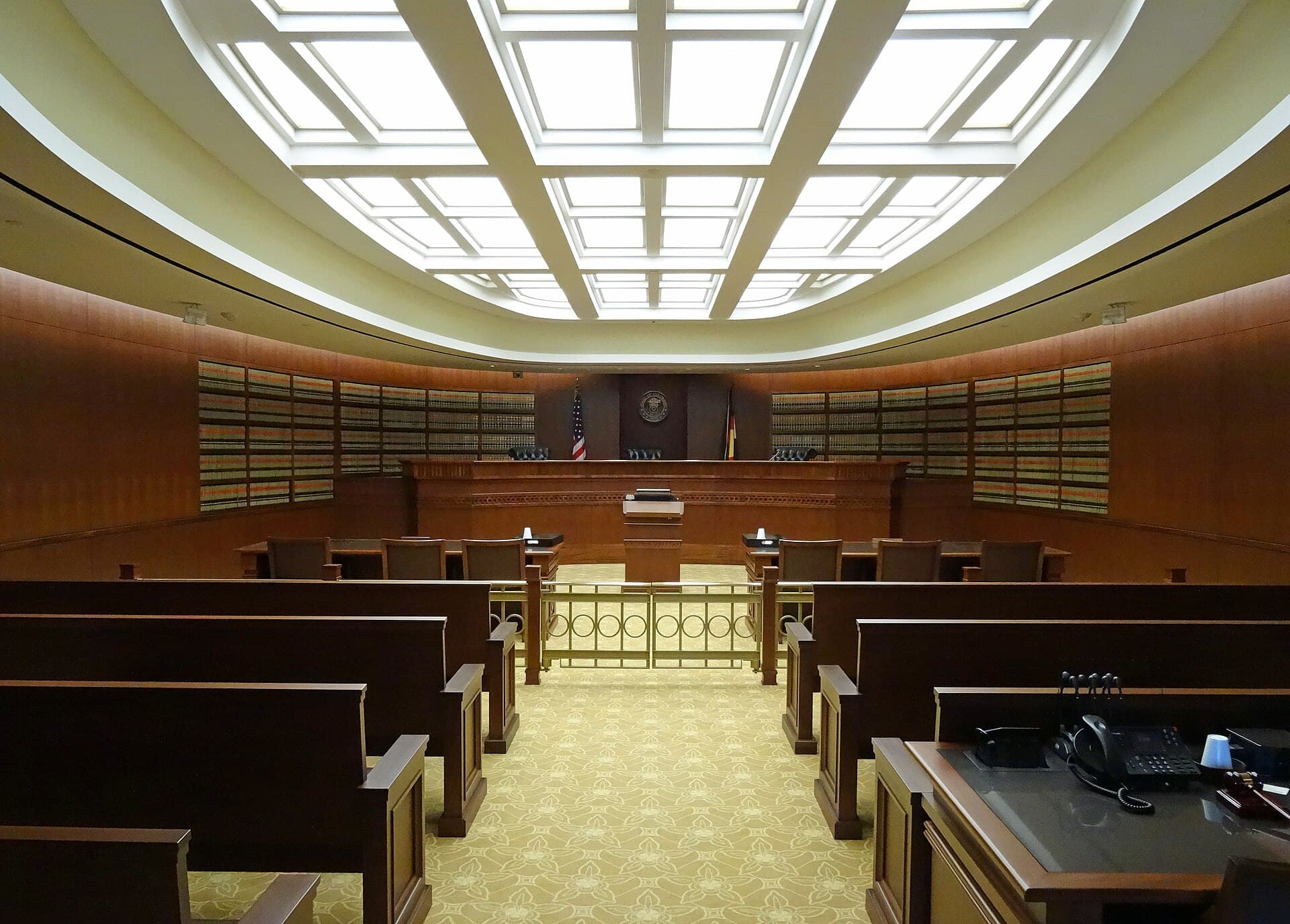
The Ralph L. Carr Colorado Judicial Center in Denver, home of the Court of Appeals. Photo: Jeffrey Beall, CC BY 3.0, via Wikimedia Commons
Grant Sullivan is a judge on the Colorado Court of Appeals, and this fall is the first time his name has been on a ballot. Douglas County voters are asked one question about him: shall he be retained in office? He has no opponent and does not campaign. Google's autocomplete for his name fills in "republican or democrat," "political party" and "who appointed," so this page starts there and works through the record: the governor's announcement, the court's records, the volunteer commission that evaluated him, and the one published argument against keeping him.
Who appointed him, and when
Gov. Jared Polis announced his appointment on Nov. 9, 2023, along with Pax Moultrie's, to fill two vacancies. Sullivan took the seat of Judge John Daniel Dailey, whose retirement was effective Jan. 1, 2024, and the court's website lists that date as his appointment date. Colorado Politics noted at the time that once the two were sworn in, Polis's appointees would make up half of the 22-member court.
New Colorado judges serve a two-year provisional term and then face voters at the next general election. He has been on the court since January 2024, and this is his first retention vote. A yes gives him a full eight-year term.
What he did before the bench
He was the state's lawyer. After the University of Texas at Austin in 2005 and the University of Colorado Law School in 2008, he clerked for Judge John Webb on the Court of Appeals, spent a year as an associate at McElroy Deutsch Mulvaney & Carpenter, and clerked for Justice Nathan Coats on the Colorado Supreme Court. In 2011 he joined the Colorado Attorney General's Office, where he stayed until his appointment. The governor's release listed him as an Assistant Solicitor General since 2012 and a Senior Assistant Attorney General II in the Public Officials Unit since 2018, handling "trial and appellate litigation on behalf of the State of Colorado." The court's biography says his work there covered "constitutional law, voting rights, election law, tax, administrative law, and appeals."
The case most people would recognize came at the end. Colorado Politics reported in its appointment story that he had "most recently" represented Secretary of State Jena Griswold "in a high-profile case about Donald Trump's eligibility to appear on the 2024 presidential primary ballot." He also served as a Supreme Court Fellow with the National Association of Attorneys General, is a past president of the Minoru Yasui American Inn of Court, and volunteered with Metro Volunteer Lawyers' post-decree clinic. On the court he takes part in the "Courts in the Community" program and, the commission says, coaches and judges for CU's mock trial and moot court programs.
What the performance commission found
The State Commission on Judicial Performance interviewed him, read a selection of his opinions, observed him in court, reviewed his self-evaluation and the survey report. Its finding: he meets performance standards, 9-0, with one commissioner absent and one seat vacant.
The commission found his opinions "consistently well-reasoned, fair, and thoughtfully articulated, demonstrating a strong command of the law and clear judicial reasoning," and said that although he joined the court only in January 2024 it saw "a strong and confident transition into the role of appellate judge." It described him as "clear, open, and highly effective in communication" and said that "while appropriately assertive in managing proceedings, the judge's tone and demeanor remained balanced."
"A strong and confident transition into the role of appellate judge." The State Commission on Judicial Performance, 2026.
The survey numbers
This is the smallest survey of the six Court of Appeals judges on the Douglas County ballot. The contractor invited 436 attorneys and 253 judges; 4 attorneys and 15 judges answered. All 15 judges said he meets standards. Three of the four attorneys said yes and one said no. His overall score was 3.7 out of 4, after 4.0 in 2024 from three respondents and 3.6 in 2025. The gap between the groups is wide: judges scored him 4.0 on general questions and 3.9 on writing, while the four attorneys scored him 3.0 and 3.1. The commission's narrative does not mention the attorney who voted no, and four respondents is a small base.
Is he a Republican or a Democrat?
The ballot does not say, because Colorado judges do not run under a party label; the Douglas County sample ballot lists him with no party, no opponent and no statement. The governor who appointed him, Jared Polis, is a Democrat, and he was chosen from a short list sent to the governor by a judicial nominating commission. For twelve years before the bench he represented the State of Colorado and its officials in whatever cases came to the Attorney General's office. He has no platform or endorsements. His opinions are public in the Colorado Judicial Branch's opinion database; we have not reviewed a sample of them for this page and will not characterize them beyond what the commission wrote.
One published argument against him exists. Dennis Maes, a retired chief judge from Pueblo, wrote in a Colorado Politics op-ed on Oct. 9 that Sullivan and Supreme Court Justice William Hood should not be retained, saying both knew about the Supreme Court's "pay-for-silence" contract scandal before it was reported and did not report it; Maes wrote that Sullivan was then an assistant solicitor general in the Attorney General's office under Phil Weiser. That is Maes's opinion; we have not verified his claims against any record, and the commission's narrative does not address them. The Douglas County Republican Party's online voter guide recommends retaining Sullivan, and we found no committee or advertising campaign against either judge.
How to vote on him
He appears in the judicial retention section of the ballot with five other Court of Appeals judges and one Supreme Court justice. A "yes" keeps him for eight years; a "no" removes him at the end of this term and the governor appoints a replacement; a majority of the votes cast on the question decides it. Retention judges do not campaign, and we found no organized opposition to him. All thirteen judges on the Douglas County ballot drew a "meets standards" finding this year; our page on all thirteen has every narrative and vote count.
More: every race and measure on your ballot, the November ballot guide, and where to vote. We do not endorse candidates or take positions on judicial retention. Corrections to hello@discoverdougco.com.
*Election night: live results for every Douglas County race, measure and judge, with the first numbers after 7 p.m. on Nov. 3. Before then: where to vote in person, every drop box, and the deadlines, and who has voted so far.*
Local DougCo news worth your inbox
We dig into the Douglas County stories — elections, development, what's opening — that the big outlets skip. Free, no spam.
No spam. Unsubscribe anytime.
Comments
Sign in with Google to commentLoading comments…